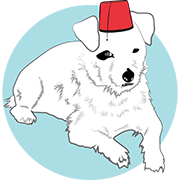
Yesterday was the fifth anniversary of adopting Frankie, my first dog, ever. In honor of that occasion, I was going to write a paean to the joys of life with a dog. Not coincidentally, however, the day Frankie was brought over to my house – in rescuer parlance, his “forever home,” a phrase I detest not only for its Hallmark soppiness, but also its inherent falsity; nothing, not even diamonds, is forever — was also my birthday. Much as I love writing, it’s also work, something I was determined not to do on my birthday this year.
I also thought of spending the day with Frankie but he’s really not very sentimental and wouldn’t have appreciated the gesture (except in the general sense of liking to have me around to cater to him). He would, on the other hand, have been very annoyed to discover that I put on my other hat, food writer, and drove up to Scottsdale for an amazing lunch at Michael Mina’s Bourbon Steak (hint: Kobe beef and sirloin were involved) in which he didn’t partake. And hell no, there were no leftovers.
So the task of doing a retrospective fell to me today.
I then contemplated writing about what each year of our lives together would signify — you know, like kibble for the first year being the equivalent of a human paper anniversary — but soon started wondering whether I needed to factor in the seven dog years equals one human year formula, which has been modified anyway. This began to involve higher math.
More to the point, the idea of our anniversary described in human romantic terms began to seem a bit creepy. I also feel that way about the term “pet parent,” incidentally, with its implications of interspecies interbreeding. If I am Frankie’s “mom” — a term I never used to refer to my actual mother — who is his “dad”? What would I have had to do with him and why don’t I recall the occasion? And why doesn’t Frankie resemble me in the slightest?
So then it occurred to me that I addressed this question in — shameless self promotion alert — my new book, AM I BORING MY DOG.
2. Will getting a dog change my life dramatically?
Yes, and irrevocably– but in a good way. Unless you have a tiny, flinty heart, in which case you shouldn’t inflict your mean self on a dog or any other living creature.
It struck me that I used to worry that maybe I did have a tiny, flinty heart, that I was incapable of the sacrifice involved in caring for another creature. After all, I’d never wanted a human child (yes, I’m an unnatural woman; get over it).
I was wrong.
Not only did the depth of my feeling for this funny alien creature throw me for a loop; I was also surprised by my ability to cope with the day-to-day details of his care. To use an extreme example, when I discovered Frankie had diabetes first I threw myself on the floor and wept. And then I got on with the task of dealing with it. Am I crazy about giving him shots and fussing over his diet? No way. But I sure am pleased to discover that caretaking is not beyond my capabilities.
Hmmm. Even if the term gives me the heebie jeebies, maybe I was cut out to be a dog mom after all.


The Kindness of Strangers
It’s easy to become cynical about human nature. Just open the newspaper to any random page and you’ll likely find a story of cruelty and stupidity.
And even the well-intentioned can be overwhelmed by the difficulty of improving the world. Most of the readers of this blog, say, would love to help dogs, but may not have a clear idea of how to do that. I usually count myself among them.
So I’m passing along a two-fer: An opportunity to redeem your faith in human nature and to help a dog.
Jim McBean of DoggyBytes.ca isn’t exactly a stranger — he’s been a guest blogger on this site — but I don’t know his cousin Theresa. Or her family. I do know, through Jim’s blog today, that their dog, Ginger (aka Shugie), needs life-saving surgery. So go over to his site and read the story. Then make a donation, even just a little one. I did, and it’s made me feel better about myself and about the world.
Try it. You’ll see.
Update: By coincidence, I just came across an article in The Week about the nature of compassion, how it’s easier to wrap your head around the plight of a single sufferer — in the article’s example, a small dog lost at sea — than a group in distress. It’s a fascinating excerpt from a book called The Hidden Brain by Shankar Vedantam. Check it out here.
Posted by Edie Jarolim