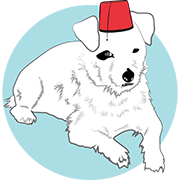
Sadie taking a reluctant break
Last week I explored the question of why the talented Deborah Flick decided to take a break from her blog, Boulder Dog, to attend classes at the Karen Pryor Training Academy. This week I get into the nitty gritty details of the experience, and find out what Deborah — and Sadie — took away from it.
Where were classes held and how was the course organized?
Classes were at the Humane Society of Boulder Valley in Boulder, CO.
The course ran for about four months and was divided into as many “units.” There was on-line work that included reading, taking quizzes, and writing assignments plus dog training exercises that I practiced with Sadie, all of which is quite time intensive. I think I devoted, on average, 10-20 hours a week depending on the written assignments, the training exercises, and how compulsive I was feeling.
Each of the four units culminated in a two-day on-site workshop in which all the students (8 in my class) and their dogs work together with the KPA instructor. Our instructor was Nan Arthur. She lives in San Diego and traveled to Boulder for the class sessions. In addition to reviewing all of our written assignments, she provided feedback regarding how well our dogs and we performed during the on-site class.
During the last on-site class in September we were evaluated on how well we performed in a ‘final’ training assessment with our dogs, and how well we did in teaching a mock dog training class in which our classmates and their dogs were the ‘learners.’
Can you describe a typical day in the program?
We’d begin the on-site classes with a welcome and warm-up. Everyone would be sitting around the HSBV training room with their dogs in crates, ex-pens, or tethered to the wall. We’d share how the previous month of training exercises went and do a little Q and A. Then we’d have “show-and-tell” during which we each would demonstrate for the class one of the training exercises we had worked on, for example, loose-leash walking with distractions.
Then we’d have some more discussion or a class activity during which we worked in pairs helping each other to teach our dogs a new behavior using one of the training techniques we had learned during the previous month. For example, I taught Sadie to turn her head and place her cheek solidly in my open hand. That was very sweet.
During the afternoon of the second day of the on-site classes, we’d have assessments. Usually we were given a new behavior to train and demonstrate. For example, for the first class I did a free-shaping exercise with Sadie where I shaped her to push a soccer cone with her nose back and forth across goals lines that were about three feet apart, and put that behavior on cue. That was fun!
How did Sadie like it?
There are two parts to this question. One is how did Sadie like learning? The other is, how did Sadie like being in the class for two days in a row?
Lucky for me, Sadie loved learning new behaviors. She was, and is, an enthusiastic learner. Often when I wanted to take a break, she’d look at me like I was out of my mind. The few times I did her bidding and continue on, we’d start to lose it. I’d mess up the sequence of cues, or click and treat for the wrong behavior. Sadie would sometimes offer a behavior other than the one I cued even though the cued behavior was one she had been reinforced for many times before. For example, I’d say “tad da,” her cue for a play bow, and Sadie would sit, which is her default behavior.
I learned the hard way that short training sessions are best. And, by short, I mean one minute or so, not much more.
As for being in classroom, I think that was a mixed bag for Sadie. When it was our turn to demonstrate for the class what we had learned, Sadie seemed to love performing in the middle of the room all bright and wiggly. But, she did not relish going back to her ex-pen despite my making her space as cushy and comfortable as possible with lots of chew toys and stuffed kongs. Sadie was exhausted by the end of the two-day, on-site classes. So was I.
What were your biggest challenges?
Pacing our training, as I mention above. Also, there’s a lot of mythos surrounding KPA classes. The amount of work and pressure to get everything completed – writing assignments and training exercises – is legendary. Unfortunately, I went into the class on edge and worried that I’d be overwhelmed. You know what they say about self-fulfilling prophecies. It took a while for me to realize that I could handle the workload just fine. All I needed to do was pace myself and set priorities.
What were your biggest rewards?
I think the biggest reward was seeing Sadie blossom. As you know, Sadie has lots of fear and reactivity issues. During the first class, Nan Arthur, our teacher, gave Sadie and me a huge compliment. She said something to the effect that you wouldn’t know just by looking at her that Sadie was a fearful dog. Sadie appears normal—and that’s what the goal is in working with a fearful dog—to help them develop the coping skills so that they seem like an okay dog even though deep down they aren’t.
Of course, leaning new training skills and receiving great feedback from Nan and my classmates was very rewarding. But, it was Sadie’s growth in confidence and remembering her joyful performances in the classroom that make my heart swell.
Deborah Flick, Ph.D. is a communication consultant and president of her own company, Collaborative Solutions Group. She is also the author of an award winning book, From Debate to Dialogue. She has been writing for her blog, Boulder Dog (www.boulderdog.net) since April, 2009. In September 2011 Deborah graduated from Karen Pryor Academy for Animal Training and Behavior.
Who Goes With Fergus? Second-Dog Syndrome
Fergus the Fabulous
It’s tough being the second child in a family. I know this from personal experience. The first-child thrill is gone so you get fewer pictures taken of you — not to mention hand-me-down clothes. You also get compared to the one who came first, and often not favorably.
But it could be worse. Much worse.
Imagine if children were born in sequence like a great many dogs are acquired — that is, one dies and, when the owner’s heart heals a bit (or in an attempt to make it so), another is brought into the household. And imagine if the previous dog was mellow and dearly beloved by all and the second dog is no angel.
That’s the case with Fergus, my BFF Clare’s new pup.
A Hard Act to Follow
In some ways, Clare’s first dog, Archie, was my first dog too. He was my inspiration for getting Frankie. I’ve written a lot about Archie and Frankie and our adventures together and I don’t want to revisit those posts, but I will link to my farewell to Archie, who died last August, just so you get an idea of what Fergus is up against.
Yep. Platonic ideal of Dog. I said that.
Enter Fergus
Clare adopted Fergus in March 2012 from a rescue that got him from a high-kill shelter. He was found, unneutered, in a bad neighborhood; scars on his eyelids suggest that he might have been encouraged to fight other dogs. He’s also young — about a year old — so he’s got a lot of energy.
Dog aggression and separation anxiety — to the point that the neighbors complained about his barking when Clare went out — has made life with Fergus less than ideal.
On the plus side, he’s never been destructive and he’s always been very affectionate. Clare says he’s a serious cuddler.
And in case you hadn’t noticed, he’s a major cutie.
I haven’t yet met Fergus but I’m looking forward to it. Frankie, who also initially suffered from being not-Archie, should find Fergus a natural ally. But he won’t.
The Progress Report
Clare hired a trainer and has been working very hard with Fergus. She’s been avoiding places where they’ll encounter other dogs but where he can get enough exercise to run freely — not an easy combination.
He’s slowly learning that being good gets more rewards than being bad, which was doubtless what he was led to believe early on. He gets along great with dogs that belong to friends of Clare that he’s encountered more than once.
It’s getting better every day. Clare no longer compares Fergus — or Gus, but never, ever Fergie, for obvious reasons — to Archie. Does she love him in the same way? Not yet. And maybe she never will. But she is dedicated to his care.
A literary legend
Archie’s full name was Archibald McLeash. It is no surprise, then, that Fergus got his name from a poem by William Butler Yeats:
I’m not going to try to analyze the intentions of this poem but you’ve got to love the idea of a dog ruling “the brazen cars” and the “shadows of the woods.” And I had to laugh at one of the lay commentaries on the poem that I found:
It’s not only Dog Whisperers who talk about alphas!
But if I’m not going to venture into my own exegesis, I do have an answer to the question posed by the title of the poem.
Who goes with Fergus? Clare does.
***
Have any of you experienced second-dog syndrome, not being quite as enamored with a second dog as with a first? What, if anything, did you do about it?